-
Author
Hēmi Kelly
-
Last updated
Sep 2026
-
Time to read
7 mins
Before we get into learning, here’s a little context. In Aotearoa New Zealand, you’ll often hear the Māori language referred to simply as te reo — “the language”. Te reo Māori, the Indigenous language of Aotearoa, became an official language in 1987 after decades of advocacy for its recognition, protection and revitalisation. Today, it’s visible and audible everywhere.
About the author
Hēmi Kelly
Māori teacher, translator and writer
I’m a Māori teacher, translator and writer, but I was once a learner too. Growing up in a bicultural whānau, I was eager to learn more about my Māori side. That journey led me to teach te reo at tertiary level, and now I work with organisations nationwide through Tautika Ltd.
Teaching remains one of my greatest passions, and one of the questions I’m asked most often as a kaiako (teacher) is: Where do I start?
My answer is usually the same: start small, and start with something you can actually use.
Follow @everydaymaori on InstagramThink about the things you say every day, the people you speak to, the places you go and the things you do together. Language is much easier to remember when it has a purpose in your own life.
And if you’re visiting Tāmaki Makaurau Auckland, there are plenty of opportunities to put a little reo into practice.
Pronunciation
Before worrying about vocabulary or sentence structures, get familiar with the sounds of the language.
Te reo Māori is a phonetic language, which means words are generally pronounced as they are written. Get the five vowel sounds right, and you’re already well on your way:
A - as in art
E - as in empty
I - like the e in evening
O - as in orphan
U - like the oo in too
If you know Spanish or Japanese, you’ll recognise very similar vowel sounds.
You’ll also see vowels with a little pōtae (hat) above them: ā, ē, ī, ō, ū. This is called a macron, and it tells you to lengthen that vowel sound.
Macrons matter because they can completely change the meaning of a word. Papa (earth) and pāpā (father), or keke (cake) and kēkē (armpit), are very different words!
Learning new words
You don’t need to speak fluent Māori to incorporate te reo into your day. A notable aspect of English in Aotearoa is the way Māori words are often woven naturally into daily conversation.
See if you can figure out what the Māori word in each of these sentences means from the context:
-
“Let’s go and have some kai at that restaurant.”
-
“Where did you park the waka?”
-
“What’s the name of that giant maunga?”
You’ll hear words like these used by Māori and non-Māori speakers alike. Start noticing the Māori words you hear around you — you may already know more than you think.
Saying hello
If you learn only one expression while you’re here, make it kia ora.
Kia ora is an incredibly versatile expression. You can use it to greet someone, thank someone, acknowledge what they’ve said, agree with them or even say “cheers” as you raise a glass.
Here are three other common greetings you can use depending on how many people you’re speaking to:
-
Tēnā koe
Greetings to you - one person.
-
Tēnā kōrua
Greetings to you two.
-
Tēnā koutou
Greetings to you all - three or more.
Introduce yourself
Once you’ve said hello, the next step is introducing yourself.
-
Ko Hēmi ahau.
I’m Hēmi.
-
Ko Sarah ahau.
I’m Sarah.
-
Ko wai tō ingoa?
What is your name?
Where are you from?
We’re big on connection in Aotearoa. Asking where someone is from is another way we find connections through people and place, so don’t be surprised if someone asks:
Nō hea koe?
Where are you from?
Simply replace the underlined word with your town or country. You’ll really impress people if you learn the Māori name for your country before you arrive.
-
Nō Ītari ahau.
I’m from Italy.
-
Nō Airani ahau.
I’m from Ireland.
-
Nō Ahitereiria ahau.
I’m from Australia.
Where is the…?
This is one of my favourite patterns for beginners because learning just three little words gives you a question you can use all over Tāmaki Makaurau.
The useful pattern is:
Kei hea te…?
Where is the…?
Then simply add the thing you’re looking for:
-
Kei hea te wharepaku?
Where is the bathroom?
-
Kei hea te tūnga pahi?
Where is the bus stop?
-
Kei hea te whare taonga?
Where is the museum?
Ordering food and drink
Time for a kawhe? Here’s another simple pattern that will take you a long way. Change the underlined word for whatever you’d like:
-
He kawhe māku.
I’ll have a coffee.
-
He tī māku.
I’ll have a tea.
-
He hanawiti māku.
I’ll have a sandwich.
When it’s your turn to order, try:
Tēnā koe. He kawhe māku. Kia ora!
Hello. I’ll have a coffee. Thank you!
And don’t worry about searching for a direct equivalent of the English word please. Te reo Māori doesn’t use please in quite the same way English does. Politeness comes through the construction, the context and, importantly, your tone.
Expressing admiration
You’re going to see some pretty spectacular things while exploring Tāmaki Makaurau, so here’s a useful pattern for expressing your admiration.
Change the underlined descriptive word for the word you need:
-
Te ātaahua hoki!
How beautiful!
-
Te reka hoki!
How tasty!
-
Te mīharo hoki!
How amazing!
Learn with the people around you
Language isn’t much fun in isolation. After all, its purpose is communication. Think about who you can learn and speak with. What do you do together? Where do you go? What are the things you find yourself saying over and over again?
If you’re travelling with children, for example, instructions are an easy place to start:
-
Kia tere!
Be quick!
-
Kia kaha!
Be strong!
-
Kia tau!
Be still!

Give it a go around Tāmaki Makaurau
The most important part of learning any language is using it — and Tāmaki Makaurau gives you plenty of opportunities.
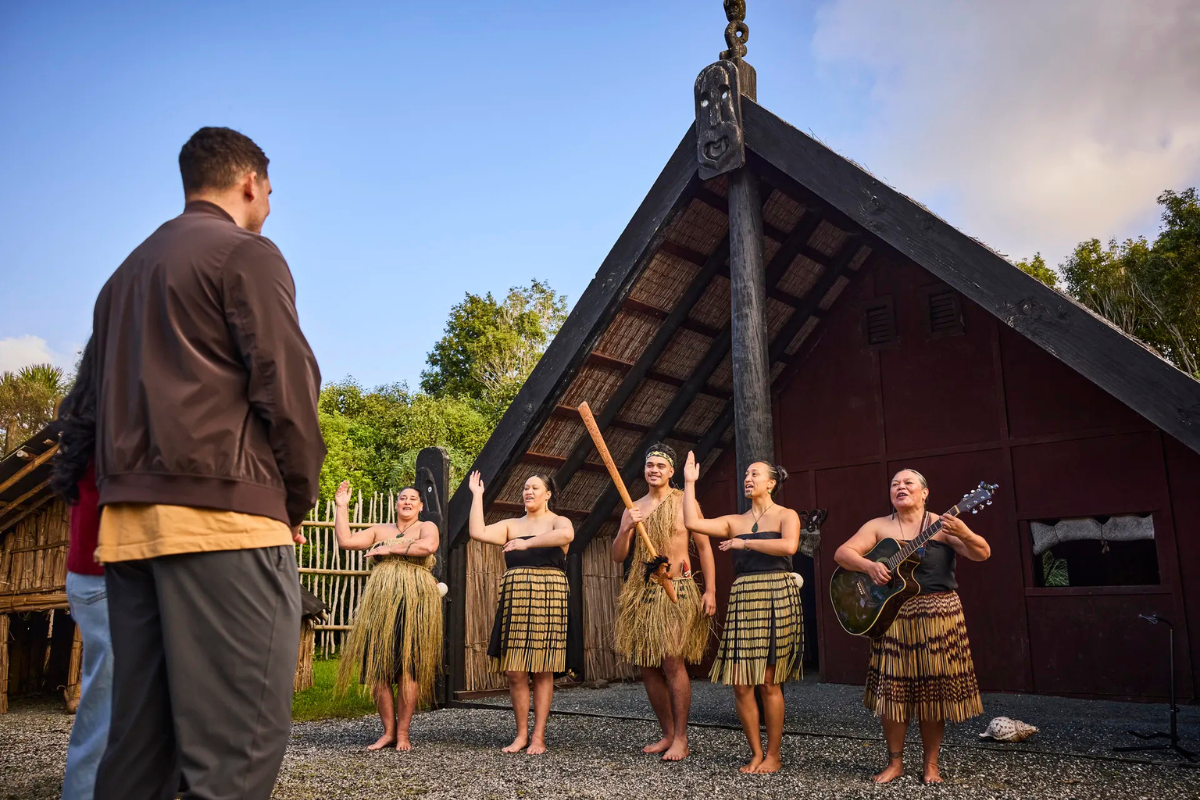
The Treasures of Tāmaki Makaurau businesses are some of the best places to begin. These Māori tourism operators and experiences provide opportunities not only to hear and see te reo Māori, but to engage with the language as part of the living culture of this place.
You can also encounter te reo at Auckland’s Places of Cultural Connection, including Auckland Art Gallery Toi o Tāmaki, Te Whatu Stardome, Auckland Museum and Te Paparahi Toi Māori.
These are places where te reo isn’t simply something written in a guidebook. It belongs to the whenua you’re standing on, the stories being shared and the people you’re meeting.
So give it a go. Practice and repetition are key. Once you begin learning te reo, you’ll also begin noticing just how much of it is already around you.
And remember, you don’t have to wait until you know everything before you start speaking. Start with one word, one phrase or one pattern and build from there.
If you’d like to keep learning after your visit, there are many kaiako and content creators sharing te reo Māori online. You can find my lessons, videos and podcast through @everydaymaori.
Kia kaha te kōrero Māori!
Give speaking Māori a go!